
What If Being Right About AI Is Actually Bearish? A Few Thoughts
The 2028 Global Intelligence Crisis: Why AI Might Be More Bearish Than We Think

THE 2028 GLOBAL INTELLIGENCE CRISIS
This is a famous article by Citrini published two weeks ago. You can imagine how much impact it has on the US stock market at that day. All the software companies, especially the SAAS companies, have been hit hard by the news. The stock price of traditional software companies like Atlassian (TEAM), Salesforce (CRM), ServiceNow (NOW), Workday (WDAY), Intuit (INTU), HubSpot (HUBS), and Datadog (DDOG) all took a serious hit. The software ETF IGV has already dropped 30% since its peak in September 2025, while the broader tech index (XLK) stayed flat and semiconductors (SMH) were actually up 30% over the same period.
What if our AI bullishness continues to be right…and what if that’s actually bearish?
To be honest, I don’t believe AI is as powerful as the authors think. If you have read the paper of Transformer and understand the principle of attention, you will find that the model is not as powerful as it seems.
I don’t deny that SaaS companies are facing a huge challenge, it is true that the companies who need a solution will be more feasible to use the AI solutions or even build by themselves with AI really efficiently. But I don’t think the AI will replace the traditional software and SAAS companies. Because writing the code is not the only thing that software companies do, they also are expert in certain domain, they have a lot of experience in the industry, they have a lot of data and they have a lot of users.
In terms of Crisis
Admittedly, AI still has the power and ability to replace so much fundamental jobs. Especially the jobs belonging to the middle class, like the white collar, and this is a big problem.
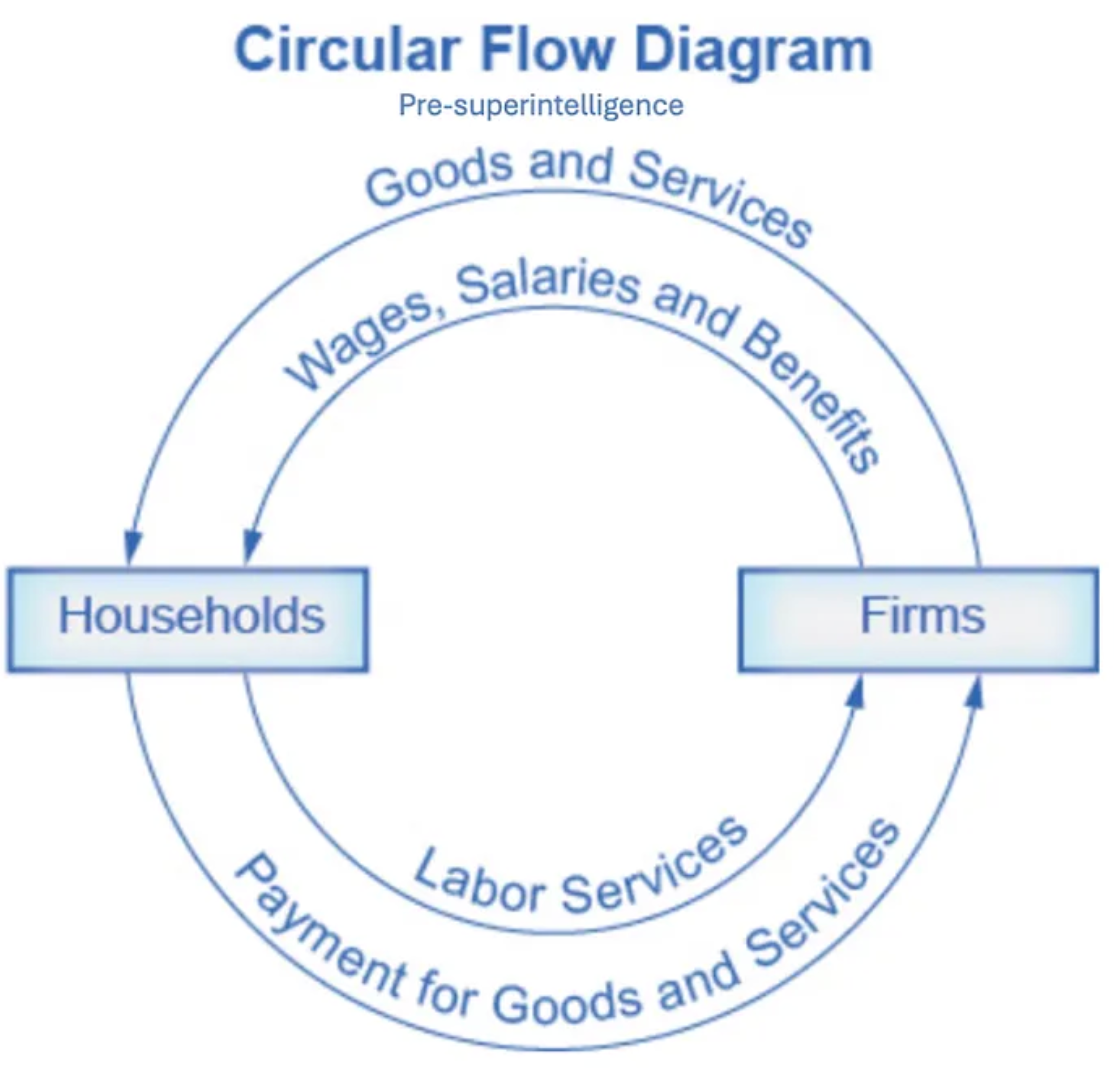
During our financial course, we have learned about how is the money made and how is it flowing through the system. Here is the circular flow diagram. As you can see households provide labor and capital to firms, and in return they receive wages and dividends. Firms produce goods and services, which are consumed by households. The government collects taxes from both households and firms, and provides public goods and services. The financial sector facilitates the flow of money between households, firms, and the government.
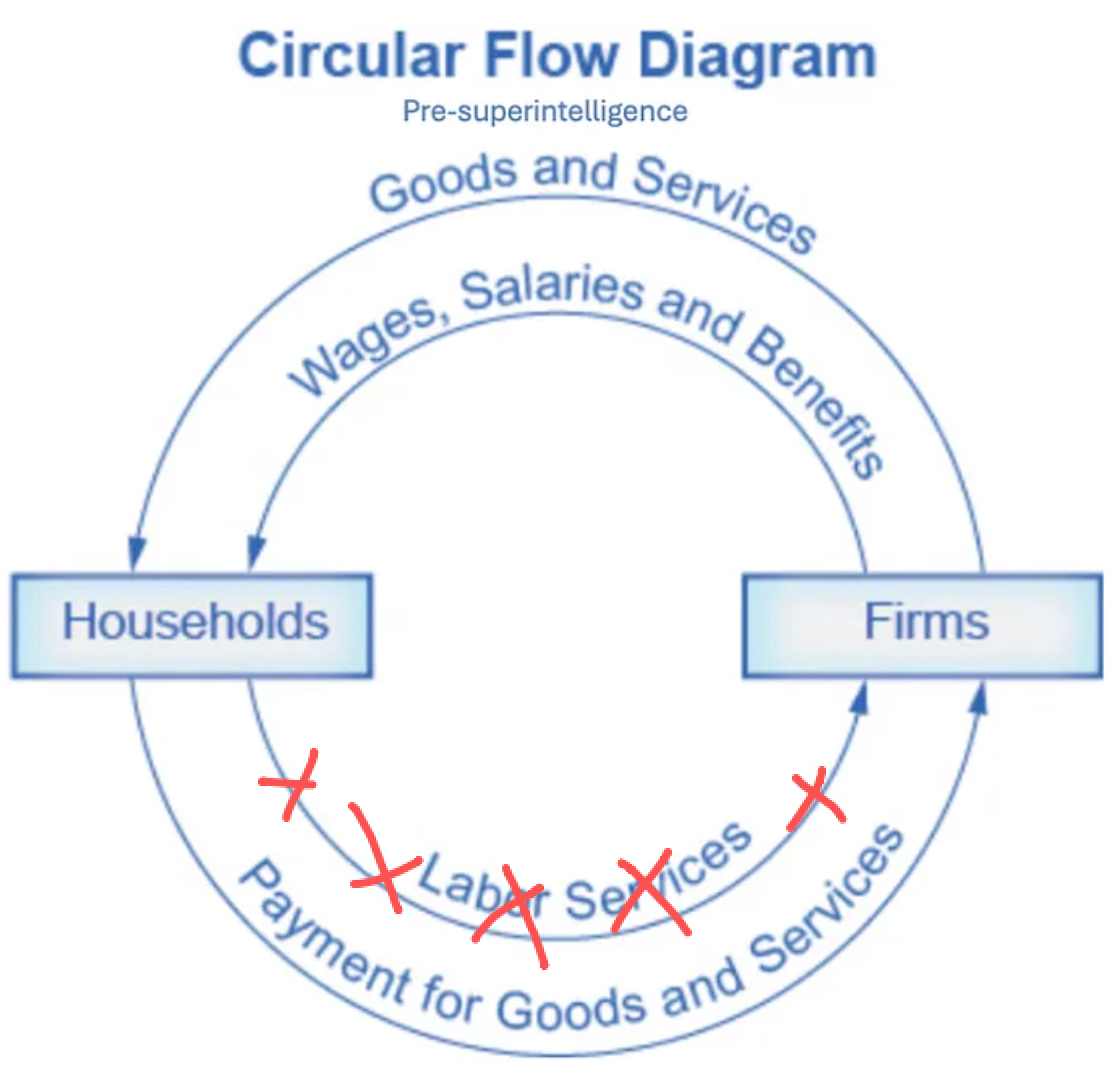
Now all the company don’t need to hire so many white collar workers any more, as you can see the Labor market arrow is breaking, and the money flow is also breaking. This is a big problem, and it will lead to a lot of social problems, like the unemployment, the poverty, the inequality, and the social unrest.
In the article, the author mentioned it could be a solution that the profit of high tech companies could be taxed and redistributed to the society. But that is impossible in America, because the government is controlled by the high tech companies, and they will never allow that to happen. Not to mention the argument between the Democrats and the Republicans, they will never agree on that. Even as powerful as the Chinese government and as a socialist country, it is also hard to do that in my opinion.
So maybe the market is panicking about the wrong thing. The real question is not whether AI will replace Salesforce — it probably won’t. The real question is whether the people who used to pay for Salesforce can still afford to.
I know history has a standard rebuttal to this kind of fear. When the spinning jenny came, weavers lost their jobs. When the automobile came, stable hands and carriage makers disappeared. But over time, new industries, new roles, and new kinds of workers emerged — more of them, in fact, than before. The economy adapted. Living standards rose. So the optimist says: relax, it always works out.
Maybe. But that argument conveniently skips the people in the middle — the ones who lived through the transition. The weavers who starved before the factories hired them. The generation that bore the cost so the next one could benefit. History is written by the winners, and the transitions look clean in hindsight. They weren’t.
This time, the displacement may be faster, broader, and harder to absorb. It’s not one industry being replaced — it’s the entire layer of cognitive, white-collar, middle-class work that modern economies were built around. When that layer thins, the circular flow breaks. Consumption drops. Demand disappears. And at that point, it doesn’t matter how good your AI is — there’s nobody left to sell to.
I genuinely hope we are not the generation that pays the price for this transition. But I’m not sure hope is enough.
Anyway, as a single individual, just keep moving forward, keep learning, and keep adapting. The future is uncertain, but we can still find ways to thrive in it.